Food Chain, Food Web and Pyramids
- hrcharitimaa
- Jun 19, 2021
- 2 min read
Food Chain
It is the sequence of transfers of matter and energy in the form of food from organism to organism.
Sun is the ultimate source of energy whose energy is passed on to the autotrophs or producers.
Trophiclevel refers to the sequential stages in a food chain, starting with producers at the bottom, followed by primary, secondary and tertiary consumers. Every level in a food chain is known as a trophic level.
The flow of energy is always unidirectional, but at every trophic level there is a loss of about 90% energy, and only 10% passes to the next step. It’s like your mother gave you 10 sweets and told you to divide it with your sister, but you keep 9 of them and give her just one. This is the 10percentlaw.
Because of this energy loss at every step, food chains do not normally constitute more than four or five trophic levels.
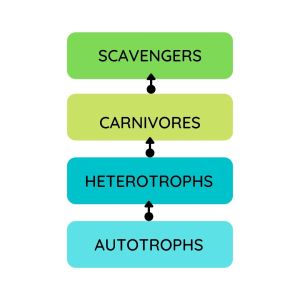
There are different types of food chains. Mainly –
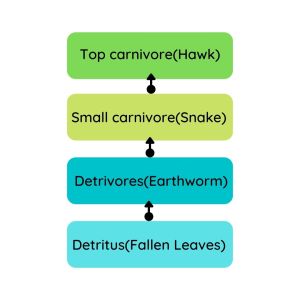
1)DETRITUSFOODCHAIN– This type of food chain begins with dead organic material. The food energy passes into decomposers and detritivores (fungi, bacteria, protozoans), which are further eaten by smaller organisms like carnivores.
2) GRAZINGFOODCHAIN – This type of food chain starts with green plants and passes through herbivores and carnivores, Energy in this food chain is acquired through photosynthesis. (Figure same as basic food chain)
IMPORTANCEOFFOODCHAIN –
Help in understanding the feeding relationships and interactions among organisms.
Helps to understand the concept of biological magnification.
Helps in understanding energy flow.
FOOD WEB
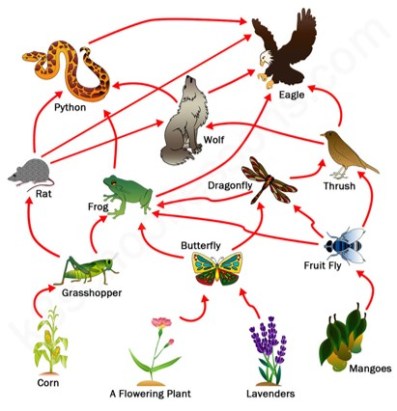
Many food chains interact together to form a food web.
This interaction happens because a single organism can be eaten by many others and similarly a single organism can eat many organisms. For e.g. A grasshopper can be eaten by both rat and frog and in addition frog also eats a butterfly. So this forms a whole network known as food web.
ECOLOGICAL PYRAMIDS
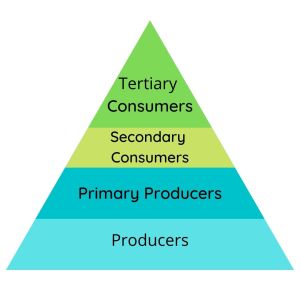
It is a graphical representation of the relationships and interactions between organisms.
The base, occupied by the producers is the broadest followed by consumers on the top.
There are different types of pyramids, namely –
1.PyramidofNumber
Each level of the pyramid represents the number of organisms in each trophic level.
The pyramid of numbers is usually upright except for some situations like that of the detritus food chain, where many organisms feed on one dead plant or animal.
2.PyramidofBiomass
Each level of the pyramid represents the amount of biomass produced in each trophic level.
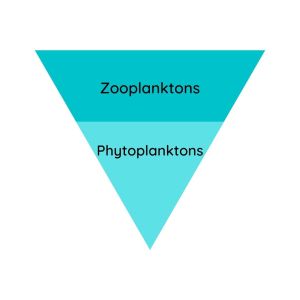
This type pf pyramid is also upright except in oceans where large numbers of zooplanktons depend on a relatively smaller number of phytoplanktons.
3.PyramidofEnergy
This pyramid shows the transfer of energy from one trophic level to another.
It is always upright, without any exceptions as energy flow is always unidirectional and is always lost according to ten percent law.
LIMITATIONSOFPYRAMIDS
Only applicable to simple food chains.
Do not show variation according to season and climate
Do not consider the possibility of the existence of the same species at different levels.
Saprophytes are not considered in any pyramid.
Comments